
Why Ledger Is Not Affected by the Coldcard Mk3 Advisory, A Simple Guide for Everyday Crypto Users

This content includes affiliate links for Ledger products. If you purchase through these links, we earn a commission at no extra cost to you. This is not financial advice. Cryptocurrency assets carry high risks, including the risk of losing your entire investment. Please do your own research and make decisions based on your personal risk tolerance.
If you've been following cryptocurrency news lately, you may have come across headlines about the Coldcard Mk3 security advisory. News like this can sound alarming, especially if you're new to self-custody. You might even wonder, "Is my hardware wallet safe?"
The good news is that Ledger hardware wallets are not affected by the Coldcard Mk3 advisory. More importantly, understanding why can help you make better decisions about protecting your digital assets.
What Happened with the Coldcard Mk3?
Think of a hardware wallet as a super-secure vault. Inside that vault is a secret key that gives you access to your cryptocurrency. When you first set up a hardware wallet, it creates a 24-word recovery phrase. This phrase is the master key to your crypto. Anyone who knows these 24 words can access your funds.
To keep your crypto safe, those words must be generated completely at random.
Imagine asking someone to pick a number between 1 and one trillion.
Now imagine they secretly limit themselves to choosing between only 1 and 10,000.
The number still looks random to you, but it comes from a much smaller group of possibilities.
That's essentially what the Coldcard Mk3 advisory was about.
Certain firmware versions on the Coldcard Mk3 produced less randomness than expected during wallet creation. That reduced the number of possible recovery phrases, making it easier, at least in theory, for a determined attacker to guess some wallets.
It wasn't that the wallets suddenly exposed users' private keys.
Why Randomness Matters
Randomness is one of the most important parts of cryptocurrency security.
Think of your recovery phrase like the combination to a giant safe. If there are trillions upon trillions of possible combinations, nobody can realistically guess yours. But if the number of possible combinations becomes much smaller, guessing becomes easier.
This is why hardware wallet manufacturers spend so much effort making sure every recovery phrase is as unpredictable as possible.
The more random the recovery phrase, the stronger the security.
Why Ledger Is Not Affected by the Coldcard Mk3 Advisory
Ledger uses a different method to generate recovery phrases. Instead of relying on the approach involved in the Coldcard advisory, Ledger generates its recovery phrases inside a Secure Element chip. You can think of the Secure Element as a miniature vault built specifically for protecting secrets. Inside this chip is a True Random Number Generator, often called a TRNG. Imagine rolling a perfectly fair electronic dice millions of times every second.
Every roll is completely unpredictable.
That unpredictability creates a recovery phrase with an enormous number of possible combinations. In simple terms, Ledger never limits itself to a smaller pool of possible recovery phrases.
Every new wallet starts with the full level of randomness expected for modern cryptographic security.
What Is a Secure Element?
Many people hear the term "Secure Element" but aren't sure what it means. A good analogy is your passport. Inside many modern passports is a security chip that stores sensitive information. That chip is specifically designed to resist tampering.
Ledger uses a similar concept.
The Secure Element protects your private keys and performs sensitive operations without exposing them to your computer or smartphone. Even if your computer gets infected with malware, your private keys remain isolated inside the Secure Element.
That's one reason hardware wallets are much safer than storing crypto in software wallets alone.
Why This Doesn't Mean Hardware Wallets Are Unsafe
Whenever a security advisory appears, some people assume all hardware wallets are suddenly risky. That's not true. In fact, security advisories often show the opposite.
Responsible companies investigate issues, publish their findings, and encourage users to update their devices when necessary. No security system is perfect. What matters is how manufacturers respond. The Coldcard advisory highlighted a specific weakness in certain firmware versions. It did not prove that hardware wallets themselves are insecure.
Ledger Donjon, Always Looking for Weaknesses
One of Ledger's biggest advantages is its dedicated security research team called Ledger Donjon. Think of Donjon as a group of ethical hackers. Their job is to attack products before criminals do. They spend their time looking for weaknesses, testing hardware, reviewing software, and researching new attack methods.
If they discover a problem, they work to fix it before it becomes a real-world threat. This constant testing helps Ledger continually strengthen its products. Security isn't something that gets finished once.
It's an ongoing process, a work-in-progress.
Why Self-Custody Still Matters
Some investors read headlines like these and wonder whether they should simply leave their cryptocurrency on an exchange. That can be convenient, but it introduces another risk.
When your crypto stays on an exchange, you don't truly control your private keys.
You're trusting someone else to protect your assets. History has shown that exchanges can be hacked, frozen, or even collapse.
A hardware wallet puts you back in control.
As long as your recovery phrase remains private and securely stored offline, only you control access to your digital assets.
Choosing the Right Ledger Wallet
Ledger offers several hardware wallets to suit different needs and budgets.
Ledger Stax
Ledger Stax is the premium choice for users who want security combined with an exceptional user experience.
Its large curved E Ink touchscreen makes reviewing transactions comfortable and easy.
Wireless charging, Bluetooth connectivity, and a sleek design make it feel like a modern consumer device while maintaining Ledger's trusted security.
It's ideal for investors managing a larger portfolio who appreciate both convenience and style.

Ledger Flex
Ledger Flex combines a spacious touchscreen with everyday portability.
The larger display makes it easier to verify wallet addresses and transaction details before approving them.
It's an excellent option for users who regularly interact with multiple cryptocurrencies and want a smooth, modern experience.

Ledger Nano Gen5
Ledger Nano Gen5 represents the latest generation of Ledger security.
Built with updated hardware and modern features, it continues Ledger's commitment to keeping private keys protected inside its Secure Element while improving usability and long-term support.
It's designed for users who want the newest Ledger platform with room for future innovation.

Ledger Nano X
Ledger Nano X remains one of Ledger's most popular devices.
Bluetooth connectivity lets you securely manage your crypto directly from your smartphone using the Ledger Live app.
Whether you're at home or traveling, you can buy, sell, swap, and manage thousands of supported digital assets without sacrificing security.
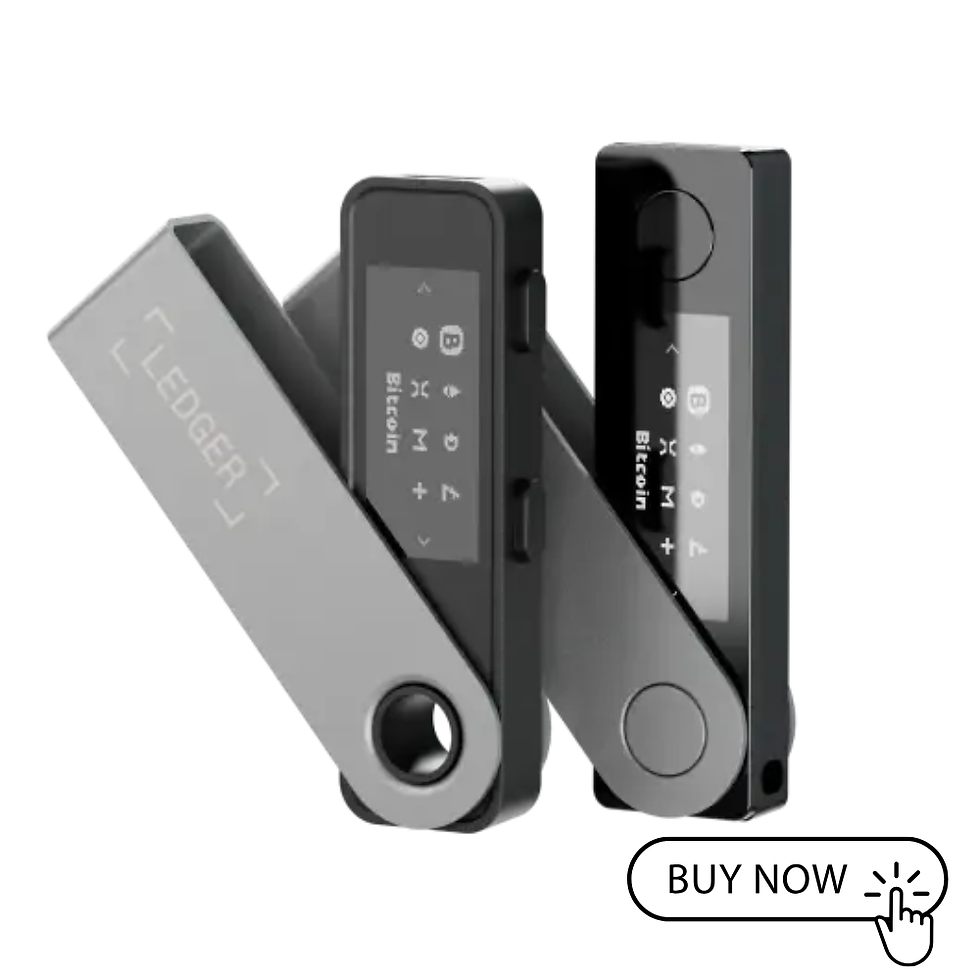
Ledger Nano S Plus
Ledger Nano S Plus offers excellent value for beginners and long-term investors.
It provides the same trusted Secure Element architecture found across the Ledger family while remaining affordable and straightforward to use.
If you're building your first self-custody setup, it's an excellent place to start.
Best Practices for Staying Safe
Regardless of which hardware wallet you use, following a few simple habits greatly improves your security.
Buy your hardware wallet directly from Ledger or an authorized reseller.
Always initialize the device yourself.
Never use a recovery phrase that comes pre-written.
Write your recovery phrase on paper or a secure backup solution and store it offline.
Never photograph or upload your recovery phrase.
Keep your firmware updated.
Verify every transaction on the hardware wallet's screen before approving it.
Ignore emails or messages asking for your recovery phrase. Ledger will never ask for it.
These habits protect you against far more threats than any single hardware vulnerability.
The Coldcard Mk3 advisory reminds us that security depends on getting every detail right, including something as fundamental as generating a truly random recovery phrase.
Fortunately, Ledger's architecture uses a different approach. Its Secure Element and built-in True Random Number Generator generate recovery phrases with the full level of randomness expected for modern cryptographic security.
Combined with rigorous testing by Ledger Donjon, Ledger hardware wallets remain among the most trusted choices for protecting digital assets. Whether you choose the elegant Ledger Stax, the versatile Ledger Flex, the latest Ledger Nano Gen5, the mobile-friendly Ledger Nano X, or the dependable Ledger Nano S Plus, you're investing in a security platform built to keep your private keys where they belong, safely under your control.
In the world of cryptocurrency, market prices will always rise and fall. New threats will continue to emerge. Technology will keep evolving. But one principle never changes.
The safest crypto is the crypto that only you can access.


Comments