
Your Ledger Has a Secret 25th Word. Most People Never Use It.

This content includes affiliate links for Ledger products. If you purchase through these links, we earn a commission at no extra cost to you. This is not financial advice. Cryptocurrency assets carry high risks, including the risk of losing your entire investment. Please do your own research and make decisions based on your personal risk tolerance.
I remember the first time I heard someone mention the 25th word of a Ledger wallet. I thought they had made a mistake. After all, every guide I had read told me that a Ledger hardware wallet comes with a 24-word Secret Recovery Phrase.
Why would anyone need another word?
The more I learned about it, the more interesting it became. This wasn't simply an extra password to unlock a wallet. It was a way to create an entirely separate wallet using the same 24 words.
Imagine someone discovering your recovery phrase and gaining access to your Bitcoin. Now imagine having another wallet that remains protected because that person doesn't know your additional secret.
That's the idea behind Ledger's 25th word.
But there's a catch. This extra layer of protection also comes with an extra responsibility. If you lose your secret, you could lose access to your cryptocurrency forever.
What Is Ledger's 25th Word?
Your Ledger Has a Secret 25th Word. Most People Never Use It: When you first set up a Ledger hardware wallet, it generates a Secret Recovery Phrase, usually consisting of 24 words.
These words are the backup to your cryptocurrency wallet. If your Ledger is lost, damaged, or stolen, you can use them to recover your accounts on a compatible wallet.
The 25th word is different.
Its proper name is a BIP39 passphrase. Unlike your original recovery words, which are generated by your device, you create this passphrase yourself. Despite its nickname, it doesn't have to be a single word. It can be a sentence, a random collection of characters, or a combination of letters, numbers, spaces, and symbols.
For example, a passphrase might look like this:
MySecretBitcoinWallet2026. This is only an illustration. Never use this example as your actual passphrase.
When you combine your original 24 words with your chosen passphrase, your Ledger generates a different set of private keys and cryptocurrency accounts.
In simple terms, you now have two separate wallets.
One Ledger, Two Different Wallets
Here's where things get interesting. Imagine that you own a Ledger hardware wallet containing Bitcoin. Your standard wallet is protected by your original 24-word recovery phrase. You decide to create a passphrase-protected wallet using the same device.
Your setup might look like this:
Wallet A
Your everyday Bitcoin wallet
Protected by your original 24-word recovery phrase.
Example balance: 0.01 BTC
Wallet B
Your long-term Bitcoin wallet. Protected by the same 24 words plus your secret passphrase.
Example balance: 1 BTC
Both wallets can be accessed using the same Ledger device, but they have different private keys and receiving addresses. Someone who discovers your original recovery phrase could access Wallet A.
However, they would also need your exact passphrase to access Wallet B.
This gives your long-term holdings an additional layer of protection against recovery phrase theft.
It doesn't make your Bitcoin completely theft-proof, though. A weak passphrase could be guessed, and someone who obtains both secrets could still access your funds.
Why Would Anyone Need a 25th Word?
Your original 24-word recovery phrase already provides extremely strong cryptographic security.
So why add another secret?
The answer has less to do with making the recovery phrase harder to guess and more to do with protecting yourself if someone discovers it.
Imagine keeping your recovery phrase written on paper inside a locked drawer. One day, someone finds that paper and photographs it without your knowledge. They now have everything needed to restore your standard wallet.
If your Bitcoin is stored in a separate passphrase-protected wallet, however, the stolen recovery phrase alone isn't enough to access those funds.
The attacker would also need your passphrase.
Another reason people use this feature is to separate their cryptocurrency holdings. You might keep a small amount of Bitcoin in your standard wallet for occasional transactions while storing your long-term holdings in a passphrase-protected account.
This allows you to manage different sets of cryptocurrency accounts without needing a separate recovery phrase for each one.
How Do You Set Up a Passphrase on Ledger?
Ledger provides two main ways to use a passphrase.
The first method is to attach your passphrase to a secondary PIN. Your normal PIN unlocks your standard wallet. Your secondary PIN unlocks your passphrase-protected wallet. This makes switching between the two wallets relatively convenient.
The second method is to use a temporary passphrase. With this approach, you enter your passphrase directly on your Ledger whenever you want to access the additional wallet.
The passphrase remains active for that session. After restarting the device, you need to enter it again. The available menus and setup process depend on your Ledger model and firmware.
Whichever method you choose, remember that your secondary PIN is not your passphrase. If you need to restore your wallet on another device, you must know the original 24 words and the exact passphrase.
The Biggest Risk Nobody Should Ignore
Imagine storing your long-term Bitcoin holdings in a passphrase-protected wallet.
Five years later, your Ledger stops working.
You purchase a replacement, enter your original 24-word recovery phrase, and successfully restore your standard wallet. But your long-term Bitcoin accounts are missing.
You suddenly remember that you used a passphrase.
Unfortunately, you can't remember whether you used capital letters, numbers, or a particular symbol. This is where the 25th word becomes dangerous.
Every different passphrase creates a different wallet.
For example, Bitcoin2026 and bitcoin2026 generate different accounts. Your Ledger won't necessarily tell you that you've entered the wrong passphrase. It can simply generate another wallet that appears empty.
If you lose your passphrase and no longer have access to a device that can open the correct wallet, your original 24 words alone cannot recover those funds.
Ledger cannot reset your forgotten passphrase. The lesson is simple. Your 25th word deserves the same care as your original recovery phrase.
Keep an exact offline backup in a secure location, separate from your 24 words. Avoid relying on memory alone. Never photograph your recovery phrase or passphrase, upload them to cloud storage, or enter them into a website asking to verify your wallet.
Can You Add a 25th Word to an Existing Bitcoin Wallet?
Yes, but activating a passphrase doesn't automatically move your existing Bitcoin into the new wallet.
Your passphrase-protected wallet has its own receiving addresses. To protect Bitcoin already held in your standard wallet, you must transfer it to an address belonging to your new passphrase-protected account. Before moving a large amount, make sure you can access the new wallet reliably.
Check the receiving address on your Ledger's trusted screen. Send a small test transaction first.
Most importantly, verify that you can restore the correct passphrase-protected accounts before depending on them for long-term storage.
Protect Your Crypto With a Ledger Hardware Wallet
Whether you use the standard 24-word recovery phrase or add an optional passphrase, a hardware wallet helps you keep your private keys away from your everyday internet-connected devices.
Ledger offers several models for different preferences, from compact wallets to touchscreen devices.
Ledger Stax
Ledger Stax features a curved E Ink touchscreen and a distinctive design that makes reviewing transactions and managing your cryptocurrency more comfortable.
Its large display makes it an appealing option for people who want a premium hardware wallet experience.

Ledger Flex
Ledger Flex combines a clear E Ink touchscreen with a compact design.
It's designed for people who want to review transaction details directly on their hardware wallet without carrying a larger device.

Ledger Nano Gen5
Ledger Nano Gen5 brings a modern touchscreen experience to the Nano family.
Its compact design offers an alternative for cryptocurrency holders who want straightforward navigation and a dedicated device for managing their digital assets.

Ledger Nano X
Ledger Nano X offers a portable design with Bluetooth connectivity for compatible mobile devices.
It's a practical choice for people who want to manage their cryptocurrency while travelling or away from their computers.
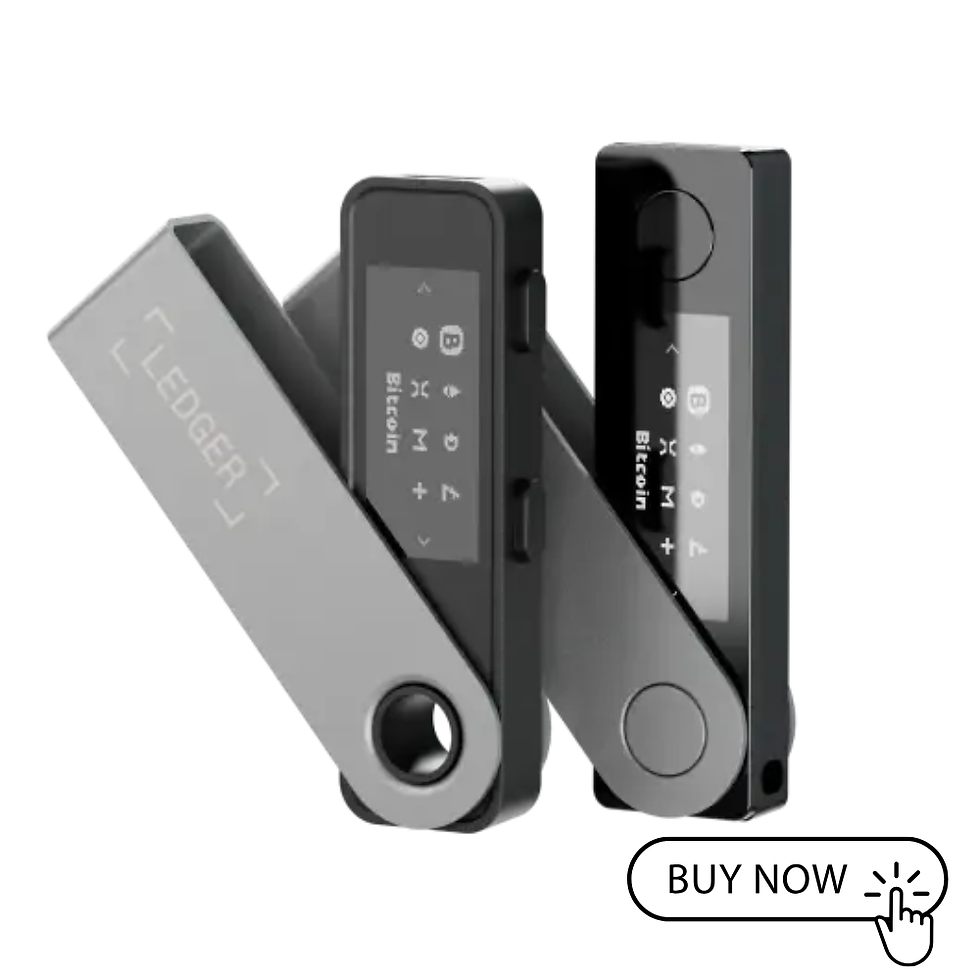
Ledger Nano S Plus
Ledger Nano S Plus offers essential hardware wallet features in a compact USB-connected device.
It provides a straightforward option for cryptocurrency holders who prefer a simple device for storing and managing their digital assets.
Explore the range at Ledger's official website. Before purchasing, check the current product specifications and passphrase support for your chosen model.
Always buy from Ledger or an authorized retailer. Set up your wallet yourself, and never use a device that arrives with a prewritten recovery phrase.
Your Ledger Has a Secret 25th Word. Most People Never Use It.: Is the 25th Word Worth Using?
The 25th word is one of the more interesting security features available to Ledger users.
It allows you to create separate cryptocurrency accounts that remain protected even if someone discovers your original recovery phrase, provided your additional passphrase stays secret and is sufficiently strong.
But stronger protection also means greater responsibility.
For someone holding Bitcoin over the next 10 or 20 years, losing an important backup could be just as damaging as having it stolen.
A carefully protected 24-word recovery phrase already offers strong security. Adding a passphrase introduces another layer, but it also creates another secret that you must preserve.
Before activating this feature, make sure you understand how to recover your wallet, how to store your passphrase safely, and how your loved ones could access your cryptocurrency if something happened to you.
Your Bitcoin deserves protection that lasts as long as you intend to hold it. Sometimes, that protection might involve a 25th word. Other times, keeping your existing recovery phrase secure and your backup process simple may be enough.
The most important thing is understanding exactly how your wallet works before trusting it with your savings.


Comments