
Bitget Hack: Why You Need a Cold Wallet (Ledger Guide)

This content includes affiliate links for Ledger products. If you purchase through these links, we earn a commission at no extra cost to you. This is not financial advice. Cryptocurrency assets carry high risks, including the risk of losing your entire investment. Please do your own research and make decisions based on your personal risk tolerance.
When I was 24, I kept my emergency money, about six months of rent in cash, in an envelope at my parents' house. I wasn't being paranoid. I figured a house with three adults and a dog was safer than my tiny flat with a flimsy door.
One Sunday my mum called. Someone had broken in through the back window. They ignored the TV and skipped her jewelry. They went straight for the envelope, tucked behind the cookbooks where I'd assumed no one would look.
The money wasn't the worst part. It was realizing I had never actually controlled its safety. I'd handed that job to a place I couldn't see, run by people I couldn't check on, and just hoped for the best.
I thought about that envelope again last week, when I read about the Bitget hack.
Bitget Hack: Why You Need a Cold Wallet (Ledger Guide) - What happened at Bitget
On September 24, Bitget, one of the bigger crypto exchanges, noticed money leaving its wallets when it shouldn't have been. Within hours, hundreds of millions of dollars in crypto had been drained. Bitget first said about $351.6 million was gone, then raised the number to around $387.5 million after counting a few more assets.
It's being called the biggest crypto hack of the year so far. Bitget's CEO has said the traces point toward a North Korean hacking group, though that's suspicion, not a proven fact.
Withdrawals were frozen while investigators, including outside security firms, dug in.
Update: Bitget is restoring customer withdrawals in phases between September 28 and October 2, 2026, following a Bitget Hack Overview that resulted in the theft of approximately $387.5 million.
The scary part isn't the size
Here's what stuck with me. According to Bitget's CEO, the attackers didn't steal any secret keys. They found a way into a system behind the scenes, fed it fake transaction information, and tricked the exchange's own approval process into signing off on the transfers.
Nobody guessed a password. Nobody got phished. The exchange's own machinery approved the theft.
So even if you had the strongest password on earth and two-factor login on everything, it wouldn't have mattered. Your safety depended on a stranger's software behaving correctly at 6:31 on a Thursday evening.
Hot wallets, cold wallets, and a shared vault
Let me explain this the way I wish someone had explained it to me.
A hot wallet is a crypto wallet that's connected to the internet. It's convenient, because you can send and receive quickly. But anything connected to the internet can, in theory, be reached by someone who shouldn't be there. Exchanges keep hot wallets because they need to process thousands of withdrawals a day.
A cold wallet keeps your secret keys offline, on a small device that never hands them to your phone, your laptop, or any website. When you want to send crypto, you approve it on the device itself, with your own fingers. The internet never sees the keys.
Keeping your coins on an exchange is like leaving your money in a big shared vault. The vault has good guards, cameras, and insurance. But it also has one front door, and everyone's money sits behind it. When a thief finds a way through, they don't just take from one person.
To be fair, Bitget says its offline cold storage wasn't touched. That's exactly the point. The parts that were offline held up. The parts that were connected didn't.
"But they're paying everyone back"
Bitget says its User Protection Fund, over $464 million, will cover the losses. If you had money there, that's good news, and I hope they follow through.
But think about what that really is: a promise. This time the fund was big enough. It's a promise that depends on the company staying solvent, staying honest, and staying online. Some past exchange collapses ended very differently.
Being covered after a disaster is not the same as never being in the disaster. I'd rather not need the safety net at all.
What a cold wallet actually does for you
With a cold wallet, your coins aren't sitting in an exchange's pool. They live on the blockchain, and only your device can approve moving them. If an exchange gets hacked, frozen, or goes bust, your coins aren't part of that story.
It's not magic. You take on the responsibility, and that's the trade. But it's a responsibility you can understand and control, unlike the security of a company you'll never meet.
The Ledger lineup, in plain English
There are a few good hardware wallet makers. I'm going to talk about Ledger here, because they have a range that suits different people. Specs and prices change, so check Ledger's official site before buying.
Ledger Nano S Plus is the simple starter. It plugs into your computer with a cable, does the job, and is friendly on the wallet. If you're just getting started and want the basics done right, this is the easy pick.
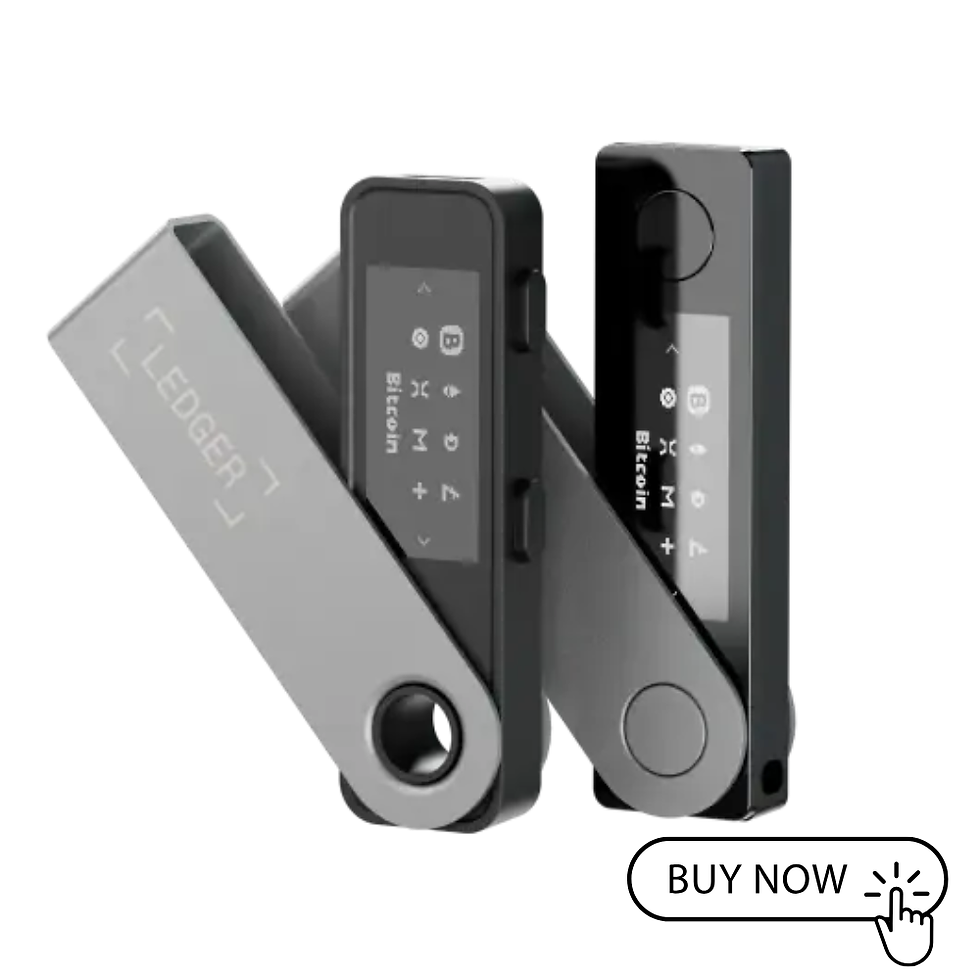
Ledger Nano X adds Bluetooth, so you can manage your crypto from your phone without plugging anything in. It's handy if you're always on the move.
Ledger Nano Gen5 is the newer generation of the pocket-sized Nano line. It's built for people who like the small format but want a more modern feel, with a touchscreen and wireless connection.

Ledger Flex has a bigger touchscreen than the Nanos, which makes it easier to read exactly what you're approving before you tap yes. That matters more than it sounds. Reading the details on a clear screen is one of the best habits in crypto.

Ledger Stax is the premium model: a large, curved screen and a design that looks like something you'd be happy to leave on your desk. If you hold a lot, or you just like nice things, this is the showpiece of the range.

They all do the same core job of keeping your keys offline. The difference is comfort, screen size, and how you like to use them. If you're unsure, start with the Nano S Plus or Flex and upgrade later.
A few habits that matter more than the device
A hardware wallet only helps if you use it properly. Here's what I tell friends:
Buy only from the official Ledger site. Fake or tampered devices sold through third-party sellers are a real scam.
Write down your recovery words on paper. When you set up the device, it'll give you a list of words. That list is the master key to your money. Keep it somewhere safe, like a fireproof box, and never photograph it or save it in your notes app.
Never type those words into a website or app. Ledger will never ask you to. Anyone who does is a scammer.
Do a small test first. Send a little crypto to your new wallet, then send it back. Get comfortable before moving the big amount.
Read the screen before you approve. The device shows you what you're signing. Look at it.
And don't panic-move everything overnight. Take a breath, set it up properly, and transfer over time.
Back to the envelope
Bitget Hack: Why You Need a Cold Wallet (Ledger Guide): After my parents' break-in, I opened a proper bank account, and later I got a small safe that only I had the code to. Nothing dramatic. I just stopped outsourcing something important to a place I couldn't check.
Crypto is the same lesson with more zeros. Exchanges are great for trading and moving things around. But for the money you can't afford to lose, the money you'd be sick over, keep the keys yourself.
Nobody wakes up hoping to learn this lesson the hard way. The Bitget hack is a free reminder. Take it.


Comments